
Looking Rich Is Costly — Why Designer Brands Keep You Poor
Designer labels sell status, not success — while you chase logos, real wealth builders quietly invest and multiply their money

This bag right here costs $300,000, and not because it’s lined with diamonds or was owned by Queen Elizabeth, but because this is a Birkin bag.
If you’re not familiar already, the Birkin bag is considered the most expensive luxury handbag in the world.
The costs range from $8,500 to $300,000 per bag, and that’s not even considering the purchasing history you need to establish with Hermes just to be considered eligible to buy a Birkin bag.
Because you can’t just walk into an AirMed store and buy a Birkin bag at the register.
You have to establish a purchasing history with Hermes, meaning you frequently buy a variety of their other products, like scarves and makeup.
Imagine if Dick’s Sporting Goods did the same thing, and just bought a basketball, you also had to buy a kayak, golf club, and some of Dwayne Johnson’s Under Armour line, be ready, ridiculous, and yet that’s the reality of buying a Birkin bag.
I would argue it is the physical epitome of manufactured exclusivity; it’s 4,000, I know, and there’s a waiting list, I assumed 5 years, for a bag.
It’s not a bag, it’s a Birkin.
And yet despite the many hoops and long wait lists that are associated with this bag, people keep flocking to it, they might save money for years just to buy one bag, which by the way you often don’t get a say in what kind of color or style of bag you get, but if you want a Birkin bag you’re gonna have to take what they give you.
- So why is this happening?
- What is so magical about this bag?
Obviously, the answer is subjective; you could argue it’s because the materials they use are super high quality or because it’s handmade by artisans, but I think the answer is a little more primal than that.
We seek social status in what we wear, where we go to school, and the handbags we carry; we want to be perceived as high-status, especially higher-status than those around us.
Designer items like the Birkin bag become this cheat code of sorts in our modern consumerist culture.
Robust generational marketing has labeled value, status, wealth, and some indescribable specialness to designer items, and those who buy into the market get messages, therefore assigning those same labels to the person owning the designer items.
The world of designer brands from Louis Vuitton to Rolex is one where social status is achieved purely through consumption and spending.
It’s a system that can easily keep you poor if you’re not careful, which is why I want to dive into this topic of designer brands for today’s story.
Let’s talk about:
- How designer brands target the poor instead of the rich?
- How do they prey on our psychology, help destroy the planet?
- How rich we could be if we didn’t spend money on designer products?
#1. Keep You Poor
These brands are targeting the poor and not the rich; they’re targeting the people who want to look rich, middle and lower class folks who don’t have that much money or savings, that is the bread and butter of designer brands.
#2. Targeting The Poor
Steve Jobs is famous for his black turtleneck look, amongst other things.
Despite his immense wealth, he always kept that same very simple look, no designer logos in sight, and this is the same case for many of the uber-rich.
- Bill and Melinda Gates
- Mackenzie Scott
- Melanie Perkins
- Mark Zuckerberg
- Whitney Wolf Herd
These aren’t people who are running around in Gucci slides and Versace belts and Louis Vuitton emblazoned outfits, no matter how much I would kill to see Bill Gates dripping in Gucci, it’d be a look.
Why don’t we see the Uber-rich in these designer brands?
I think it’s because they don’t need to prove they’re rich, we know, and I think that’s what designer brands are really selling,
- They’re selling conspicuous consumption.
- The spending and consumption of luxuries in an attempt to enhance one’s prestige
- They’re selling you a costume.
So you can pretend to look rich, except that isn’t typically what rich people actually look like.
If anything, designer brands can have the opposite effect and make people think you’re desperately trying to fit in with the rich.
Maybe this is a bit harsh, but it kind of feels like this neon sign that says I’m overcompensating, I don’t really belong with the wealthy.
How can we tell when someone is pretending to be rich, when someone is a stereotype or almost like a caricature of a rich person, the brands they wear perhaps, the brands they show on display, when you are trying too hard, and that’s usually a big giveaway when someone is just faking it, because they’re trying to overcompensate for something that is not really there.
A recent study conducted by the American Affluence Research Center and analyzed by Unity Marketing surveyed more than 300 consumers with a minimum net worth of $800k and found that many wealthy shoppers consider certain luxury brands overrated, including Louis Vuitton, Gucci, Hermes, Prada, and Rolex.
#3. Millionaire Next Door
Nearly 22 million millionaires in the US, and I bet many of them you would never know are millionaires; chances are, one of them might be your next-door neighbor.
- Unassuming
- Driving a Keo
- Shopping at Costco and TJ Maxx
“They’re not trying to be flashy; they’re not out buying the most expensive version of everything,” because they understand the value of money, the value being frugal, and making more than you spend.
Basically, the caricature of the millionaire we’ve grown up seeing on TV and now on social media requires $100k watches, jet-setting, and designer-brand outfits, but that’s not realistic; it’s just flashiness.
#4. Celebrities Wear Designer Though, Right?
You might say, “Hey, but all these celebrities and influencers I see, they’re always wearing designer, and they’re totally rich, and you’re right.”
- Duolippo wears a lot of Versace.
- Billie Eilish wears a lot of Gucci
- Kim wears a lot of Balenciaga
She should probably cut that partnership, though.
Many of us are first exposed to the designer world through our favorite celebrities, but what we don’t see is that behind the scenes, these influencers and celebrities get sent so many free products from designer brands.
To do so, because they know that it’s free marketing if that celebrity or influencer is pictured wearing or holding that item.
And some celebrities, like the ones I just mentioned, have official ambassadorship partnerships with these designer brands, where they’re paid to constantly wear their stuff.
Because of all this, there’s this illusion that designer brand items equate wealth and coolness; it feeds straight into our psychological desire to fit in and be part of an exclusive club, especially one where our peers are our rich and famous idols.
#5. Preying On Those Who Can’t Afford
This story I found of people waiting in line for the Supreme launch was especially interesting to me, because I think it nicely juxtaposed these high-ticket items with the low-earning buyers pretty well.
I collect my parents’ allowance, while also showing the alert that just the designer name alone had for these people.
Is it worth it?
Yeah, it’s worth every dime because it’s Supreme, because of Supreme.
#6. The Pretty Woman Effect
This viral story about a woman who took her mom on a Dior shopping spree after her mom was treated poorly at a Dior store.
According to the daughter, the mom had been ignored by a Dior sales rep because the mom was dressed poorly, which, you’d think, like if a store was treating my mom that way, we wouldn’t go there, how rude, but instead it kind of had the opposite effect, they went back there, and they purchased a lot of stuff.
And just looking quickly at some of the products we do online, I know that shopping sprees cost multiple thousands of dollars, as this one Dior bag costs as much as some cars and house down payments, there’s no chump change.
What’s interesting is that this rudeness the mom experienced is an alleged technique designer brands use to boost sales, and staff rudeness causes what’s known as the pretty woman effect.
Which is referencing the Julia Roberts movie Pretty Woman, where she goes and buys a ton of luxury goods after being dismissed by one of the sales reps, big mistake, big huge seller.
Marketing Professor Darren Dahl, who researched this effect, explains that a designer brand sales rep’s quote can end up having a similar effect to an in-group in high school that others aspire to join.
For the study participants who imagined or had interactions with sales representatives, rude or not, they then rated their feelings about associated brands and their desire to own them.
After being treated poorly, participants who expressed an aspiration to be associated with high-end brands reported an increased desire to own the luxury product.
#7. Trapping In The Cycle Of Chasing
Designer brands attempt to hijack our psychological desire to fit in and display status.
We want to be seen as,
- The richest person in the room
- The richest amongst our friends
- The richest person at work.
- The problem is, there’s always going to be someone richer.
It’s always going to be someone with more money, more bags, more designer things, more whatever.
Even Elon Musk, who was the richest man in the world for a while, is down 200 billion dollars.
There’s always going to be someone else, and even if he still was at the top, there’s a ton of other metrics that he’ll never be the top of, because there’s always just going to be someone else, because that’s life.
There’s always going to be someone with some other superlative that you don’t have, and it’s really easy to get caught in this cycle of chasing, chasing status symbols like designer handbags or luxury cars.
But this cycle of chasing will leave or keep most people poor.
When you’re caught in the cycle, your time isn’t your own; it’s owned by the drug of buying manufactured status.
Which is paid for by the hours of your life at a job.
The way I think about it is, the more designer items you buy, or really anything that you buy, the more of your life you’re trading away.
Obviously, we have to spend money to survive, but the level of excess that designer brands promote is not essential to live.
#8. Intention Living
I argue instead that it actually robs us of the chance to truly live. For myself, I think a lot about intentional living.
This is where you’re aware of what your personal values and beliefs are, and you try to actively make decisions that align with those values and beliefs.
It’s the reason I personally don’t buy designer goods, because the values don’t align with my values, and I think that my time and money could be spent better elsewhere, and one of the values that doesn’t align with mine is that of the designer industry’s wastefulness.
#9. Designer Brands Wastefulness
Many designer brands are notorious for intentionally destroying their excess product.
Coach was called out for it after that story that you just saw, and in 2018, Burberry was called out for incinerating its unsold products.
It’s a big problem that has caused a lot of backlash, which is understandable, because it’s kind of wild to think about products, perfectly good products, being ripped up or burnt simply to keep other people away from them.
It’s very much like Joker in The Dark Knight, causing chaos, but I think this practice nicely captures the combined wastefulness and illusion of scarcity that defines the designer world.
#10. Fashion Industry is a Menace To Our Planet
From an environmental standpoint, the fashion industry is a menace to our planet, and I know that sounds dramatic.
It kind of blew my mind to learn about how awful the fashion industry was when I first learned about its impact, but listen to this.
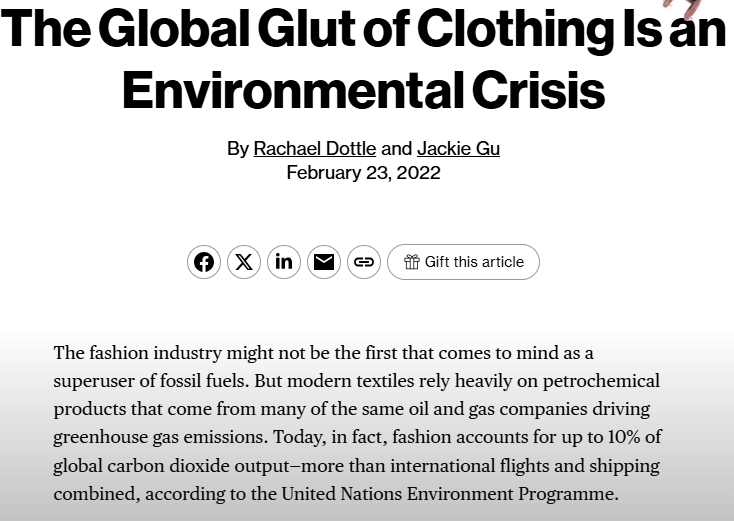
This is from a Bloomberg article, the global glut of clothing is an environmental crisis.
Quote, “fashion accounts for up to 10 of global carbon dioxide output, more than international flights and shipping combined, according to the United Nations Environment Programme.”
It’s the second most polluting industry behind oil, oil which is oil, you know.
I want to be clear, not all of that waste is from designer brands alone.
I actually think the larger culprits are fast fashion places like Xi’an and Uniqlo, because they just promote hyper overconsumption and hyper overdisposal, and really short trend cycles.
And actually, the fashion industry could probably take a few lessons from designer brands in the idea of trying to build things that are going to be more long-lasting and higher quality, so that you’re not constantly having to go buy new things.
That being said, designer brands don’t get away scot-free here. Sure, they might not be following the increasingly short trend cycles of TikTok, where styles go out of fashion within weeks, but designer brands still pump out new trends throughout the seasons, effectively adding to the culture of overconsumption, as people try to follow the latest styles.
This type of overconsumption not only hurts our planet but also our wallets.
Beyond fueling overconsumption, the materials that luxury brands use have a major impact.
You’ve got some brands using animal parts like skins and teeth to create their products, which raises their own ethical questions.
And you’ve also got the environmental impact of creating the raw materials used for the products.
Things like cotton growing, cattle farming, and mining are all incredibly energy-intensive.
With carrying the company that owns Gucci and YSL found that 75% of its environmental impact was from raw material production and processing alone.
Now I know there are a lot of facts and figures about environmental impact, and you might be like, “Hey, this story is supposed to be about money and how these brands keep me poor,” but I think that wastefulness is an inherent part of the conversation, because there is a link between climate change and poverty.
#11. Climate Change Impact On Poverty
The worse that climate change gets, the worse the divide between the rich and the poor gets.
Speaking of rich and poor, let’s talk about the opportunity cost of buying designer brands, aka how rich you could be if you didn’t buy designer items.
Investment Pices
A popular defense of buying designer items is that they are investment pieces; for some, that means that they last a long time.
Rather than just being thrown away within the year, probably true.
But I would argue you don’t have to spend designer brand prices to get something that’s higher quality.
There are a lot of other options out there that are a little more affordable.
But the other way that people mean investment piece is literally as an investment, it’s something that they can buy one day and then resell later on and make a profit from.
This is a very popular argument for our old friend, the Birkin bag. I have been collecting these bags for a minute; they’re also a great investment.
According to Time magazine in 2016, the Birkin bag outpaced both the stock market and the price of gold in the last 35 years, a time period chosen to reflect the date when Birkin bags were first produced in 1981. They say that the annual return on a Birkin was 14.2%, compared to the s p average of 8.7% a year, and gold’s negative 1.5%.
But there are a few problems with this logic. First, as we mentioned at the beginning of the story, the price tag on the Birkin bag is not the only thing that you’re going to be paying.
You have to have a purchasing history with Hermes, so you have to include that in what you’re investing, and since you’re using this as an investment piece, you’re probably going to want to take insurance out on it, which is going to cost you a pretty penny as well.
It’s weird to think about how fragile an investment something like a Birkin bag or a designer product is, especially when you compare it to more traditional investments like stocks.
Like spilling your coffee in it, have your dog get a little too curious, and suddenly you have lost $1k in resale value.
Can’t say that ever happens to me with my stock portfolio.
#12. Designer Bag vs Stocks
I thought it’d be really interesting to crunch some numbers to see how rich you could be if you didn’t buy a designer bag, and you instead invested in something like a low-cost index fund, which is one of my personal favorites.
So let’s say you have $3,500 in disposable income, which is the money that you have left over after taxes and you pay essentials.
In choice a, you decide to splurge on a 3,500 designer bag like this one from Louis Vuitton. In choice b, you decide to buy a nice quality purse from somewhere like TJ Maxx, and you put the remaining $3,450 in a brokerage account that invests in the S&P 500.
Now jumping 10 years ahead, let’s say that you can sell that Louis Vuitton bag for $3,500.
I’m putting that in there because I don’t feel like it’s a level where you could sell it for more, and also, if you’re actually using the bag, there’s probably going to be a level of wear and tear.
So we’re going to be generous and say you’re able to sell it for the same amount that you bought it, profit being $0.
Looking at choice B, though, and using the S&P 500’s historical average of 11.8% growth.
Your $3,450 has now become $10,525, that’s a $7,075 increase.
If you’re paid the national average of 28.10 an hour, and you work 40 hours a week, that growth equals six and a half weeks of your working life.
That’s a month and a half earlier than you could retire and live the life of your dreams.
And if choice A continues to buy designer products throughout their life, the gap between their life and the wealth they could be building is going to continue to grow.
And look, for some people that might be totally, totally worth it, and that’s fine.
The social signaling and the enjoyment that they get from having designer products might be worth more than that extra time not working or building up wealth.
Despite all my personal opinions, people can and will choose what they want to spend their time and money on.
But what I hope this thought experiment, and this video overall, can do is to help us think a little bit differently about designer brands, and how we spend our money.
Money is time, and I think it’s always a good idea to reflect on how we are spending both of them.
So what do you think?
Have you bought a designer before, and did you feel like it was worth the high price tag, or not really?