
You Don’t Need Passion First — You Need a Smarter Career Strategy
Finding work you love isn’t luck. It’s about aligning your skills, interests, and income potential the right way.

So I never really made my career decisions on my own.
Whatever my parents said, whatever my relatives suggested, or whichever course my friends were enrolling in, I just took admission in the same one.
Basically, I was more in a “monkey see, monkey do” kind of situation.
But it is so important to figure out which field or career is actually the right fit for you because more than half of our lives are spent working.
Out of 24 hours, we dedicate around 9–10 hours just to our job. And choosing a career where you have to force yourself every single day to go to work — that’s not good.
So today, I want to share some advice based on my own experiences and some books I’ve read on this topic, which can help you choose the right career for yourself.
So yeah, let’s get started with the story.
Advice #1: Try Out Multiple Things
When we have so many options, and we’re clueless about what to do in life, the best approach is to try as many things as possible that are available to us.
For example, an artist tries different media of art. They do sketching, clay painting, and oil painting — after trying many mediums, they figure out where their mastery and interest truly lie, and then they pursue that.
Similarly, if we try different options, we get clarity about which direction we should go in and what suits us best.
In fact, I did the same thing. When I was very confused about what to do besides a job, I used to attend workshops and explore courses.
And back then, there weren’t even that many options.
Today, there are so many fields like AI, digital marketing, data analysis, UX/UI design, and much more.
You can explore these through workshops or YouTube.
Digital marketing, for example, is among the top 10 most in-demand jobs today.
Marketing has become make-or-break for every company, and as businesses continue shifting online, the demand for skilled digital marketers is increasing rapidly.
Advice #2: Niche Things Down
Finding the right career often starts with knowing yourself better. Most of the time, we label ourselves too broadly, like “I want to become an engineer,” “a scientist,” or “a doctor.” But even being a doctor is a very broad field.
You need to ask yourself what specific aspect of the profession you actually enjoy.
Do you like interacting with patients? Assisting senior doctors? Running your own clinic? Or are you more interested in medical research?
Based on that, you can decide whether you should explore family medicine, pharmaceutical research, pathology, or something else.
So I would suggest making a list of all the career options available to you and then breaking each profession down into all the processes and roles involved in that field.
But this self-awareness process can be a bit difficult, so I’ll share some self-reflective questions with you.
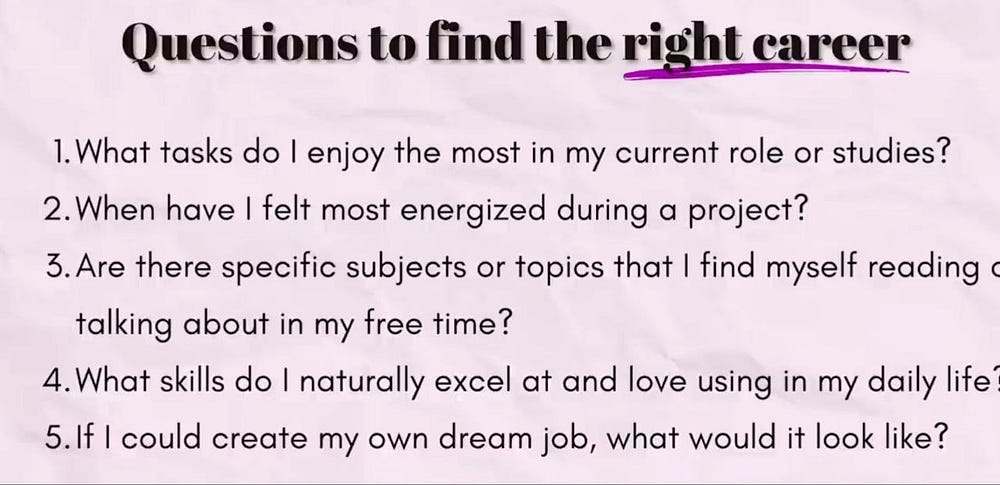
Try answering them because they can help you find the right career for yourself.
Let me give you another example.
Suppose you want to become an actor. Your mimicry and dialogue delivery are really good, so someone suggests that you become an actor.
But an actor needs much more than mimicry. You need a strong personality, many skills, theater experience, camera confidence, good looks, and several other qualities.
If you try becoming an actor based only on dialogue delivery, standing in long audition lines every day, there’s a chance you may not get selected — and that could demotivate you.
So if you feel your dialogue delivery is strong, maybe you should try voice acting, content creation, or public speaking instead.
This way, you can use your talent in the right direction.
Advice #2: Find Your Strengths & Weaknesses.
Understanding them is extremely important when choosing the right career.
Most of the time, we judge strengths and weaknesses based on outcomes. But I once watched an old video by Ali Abdaal where he said: strengths are activities that give you energy, and weaknesses are activities that drain your energy.
And I completely agree with this.
For example, you might score very high in science because you stayed up all night studying hard.
But after studying, you feel completely drained and don’t enjoy science at all. That’s still your weakness, no matter how high your score is.
On the other hand, suppose you love writing. Maybe you write poems or poetry every night before sleeping.
Even if you’re not that good at it yet, it’s still your strength because it gives you energy instead of taking it away.
You also need to make a list of your strengths and weaknesses. This can be difficult, so I’ll provide the same questions I used during my self-awareness journey.
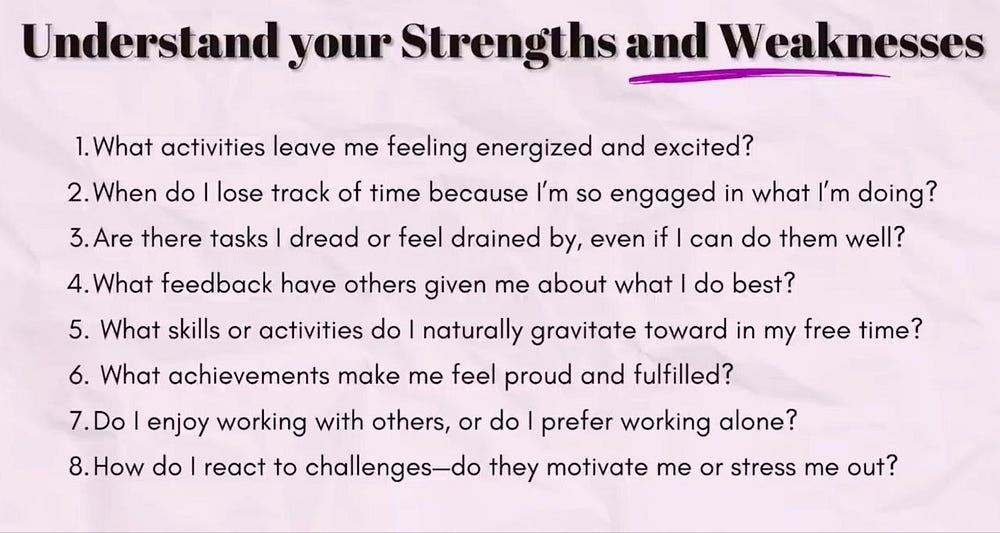
Honestly, this activity won’t happen without pen and paper.
If you’re genuinely serious about your career, then sit down, take some time, answer all these questions, and try to figure out what you really want to do in life, where you are right now, and where you want to go.
And remember, when you identify strengths and weaknesses based on your energy, you may feel like you’re not good at something yet.
For example, in my case, the media field wasn’t natural for me at all — I wasn’t good at it.
But I was interested in it, so I quickly kept learning and improving. Similarly, you might not be good at communication or marketing right now, but if you enjoy doing it, then consider it a strength.
And you have to be completely okay with not being good at it initially because if you’re interested, you’ll grow quickly.
Advice #4: Seek Help & Educate Yourself
Whatever career options you have, make sure you research them properly from A to Z.
Take time out and start researching. Visit websites, read articles, call universities, and ask about the courses they offer.
There’s no need to feel shy. You have to stand up for yourself. Call confidently — even 10 or 12 times if needed.
Seek help until you get answers. Talk to 10–15 people because talking to just one or two people isn’t enough.
Another thing I would suggest is reaching out to a career counselor.
They may charge a one-time fee, but it can help you understand yourself better — what kind of person you are, which fields might suit you, and what career options are available in today’s market.
But again, some career counselors charge very high fees, and I’ve also heard about scams.
Before going to any counselor or taking any test, proper research is extremely important.
You should already have some idea about which field you want to enter and what that field actually involves.
So yeah, guys, I hope this was helpful. If I were able to help you in any way in deciding your career, I’d genuinely feel very happy about it.
But please make sure you take screenshots of the questions I shared and answer them.
Maybe those answers could genuinely change your life.
Subscribe to My Free Substack Newsletter & Get a Free Financial Toolkit in Your Inbox.