
The New American Dream Costs $2.3 Million — Here’s Why
Most Americans aren’t chasing luxury - they’re chasing peace of mind. And that now comes with a $2.3M price tag.

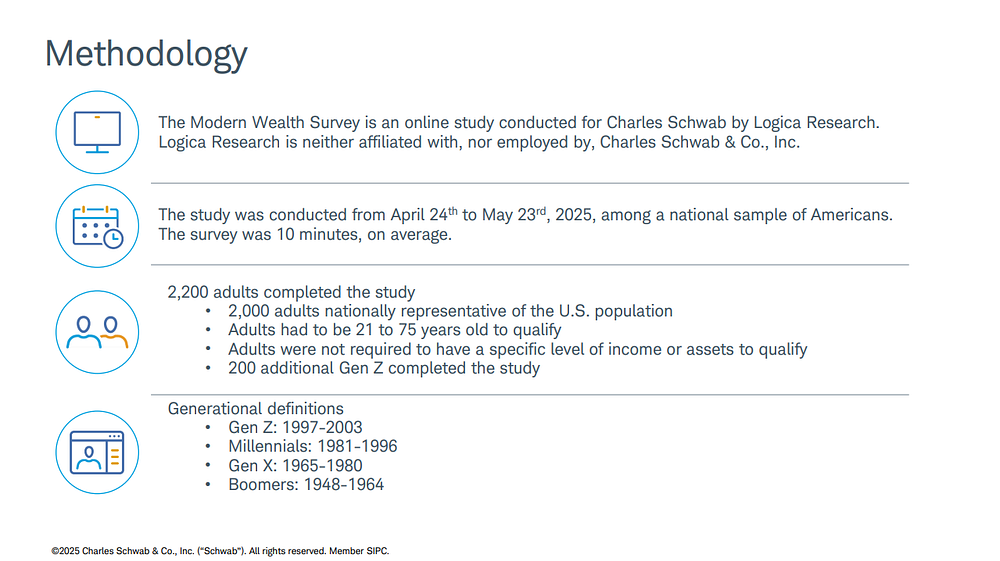
Charles Schwab recently reported in its 2025 Modern Wealth Survey that, among 2,200 adults ages 21 to 75, Americans believe it takes $2.3 million to be wealthy and even $839,000 to be financially comfortable.
With that said, let’s first go over the shocking numbers computed from the 2025 Modern Wealth Survey.
1. The Shocking Numbers
Now, data from this survey has been collected for five years straight, where, back in 2021, to be wealthy, Americans felt that $1.9 million would do it.
And interestingly enough, the number declined from last year’s expectation.
But the same upward trend also follows for what it takes to be financially comfortable, where, back in 2021, Americans felt that you needed $624,000.
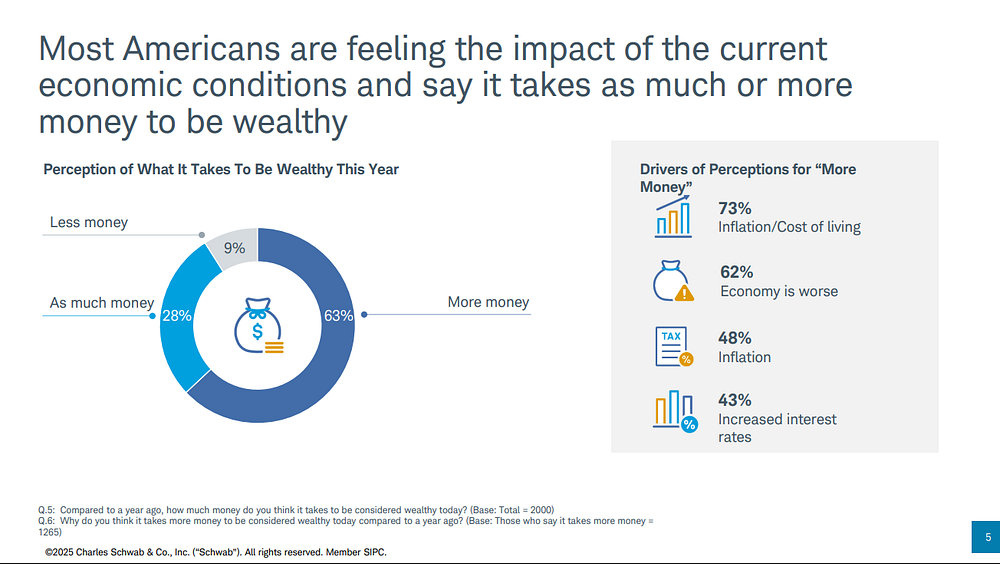
And from there, when Americans were asked how much money they think it takes to be considered wealthy today rather than last year, 63% said it takes more money, with the primary driver being inflation, which is the increased cost of living.
Now, yes, prices continue to rise over time, and the limits on things like tax brackets, standard deductions, and retirement accounts tend to increase as well.
But more importantly, when asked what it actually means to be wealthy, Americans gave equal weight to happiness at 45% than the amount of money one has at 44%.
But the thing here is that 8 in 10 Americans feel the most wealthy when it comes to the quality of their relationships, happiness, and free time that they have.
But the lowest answer on the list was only 49% feel wealthy based on the money they have.
This shows that many Americans feel the wealthiest in nearly every part of their life except their bank account.
But what’s interesting is that the results based on each generation came to show that Gen Z thinks it takes $1.7 million to be considered wealthy.
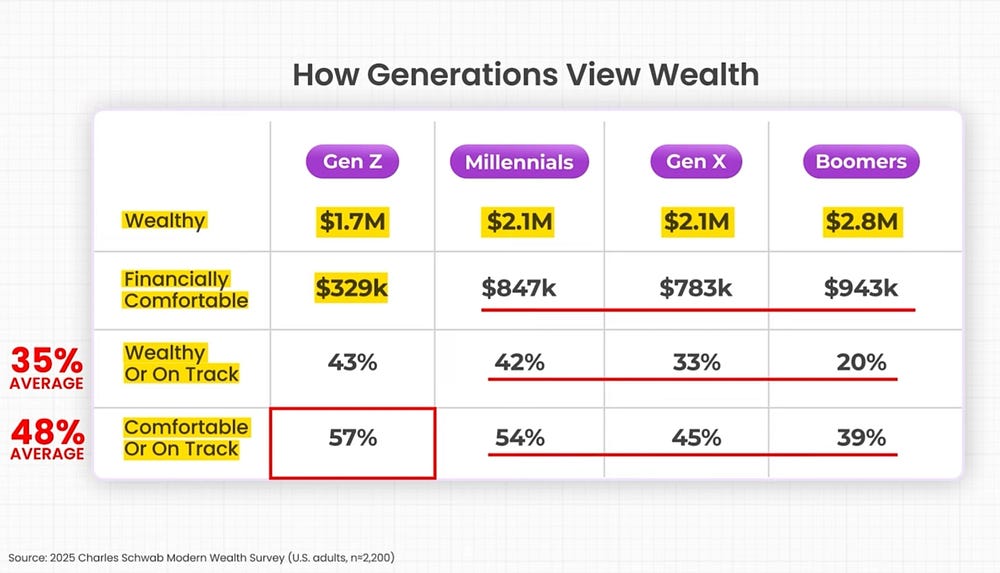
Millennials say 2.1 million, Gen X says the same, and baby boomers say $2.8 million.
And when it comes to being financially comfortable, Gen Z says $329,000, which is an outlier to the rest, who believe the $800 to $900,000 range is what it takes.
And so, looking even further into the data, 35% of the individuals that were surveyed felt they were already wealthy or on track, where Gen Z was surprisingly the highest generation, then millennials, Gen X, and then baby boomers.
And interestingly enough, the pattern continues for being financially comfortable, where 48% say that they are comfortable or on track, with Gen Z leading the votes as well.
Then millennials, Gen X, and then baby boomers. Now, understand that this data isn’t a true representation of all of America because they only questioned 2200 adults, where 285 of them were Gen Z, 822 were millennials, 602 were Gen X, and 491 were baby boomers.
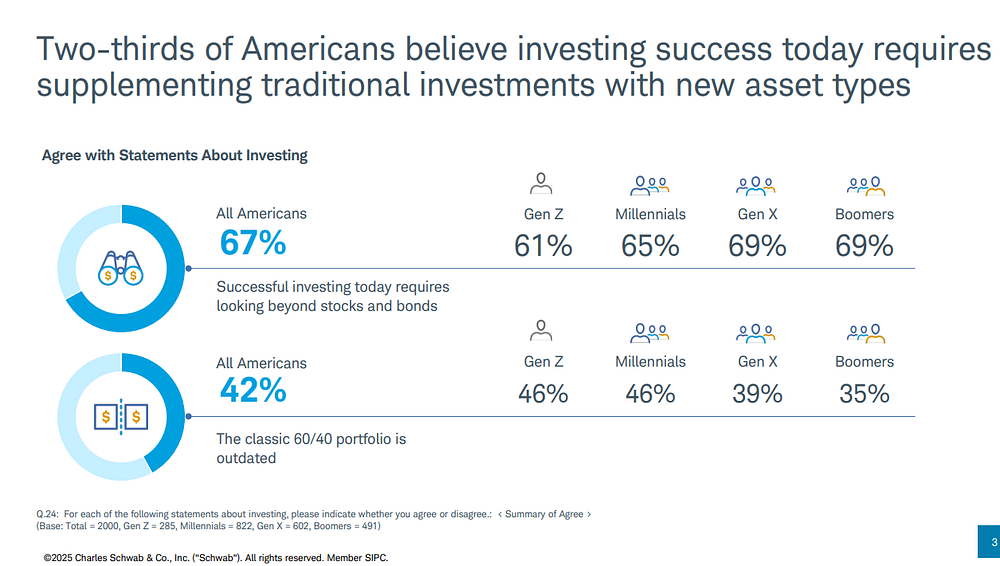
But from another modern wealth study of Charles Schwab’s that was just released in October 2025, they computed that 67% of Americans believe successful investing today requires looking beyond stocks and bonds.
And more than half of Americans believe investing today requires more short-term risk-taking than in the past.
In fact, their study came to show that more investors say they are trading investments more frequently than when they first started and that many more investors are trading investments within one year, which doesn’t forget any gains that are captured within one year of holding an investment.
They’re going to be taxed as short-term capital gains, which is much higher than if you held the investment for more than one year before selling it.
And then, when asked what the biggest barriers are for Americans to start investing, the one that came out on top by far is that they don’t have enough money to invest.
2. Why Americans Feel Broke
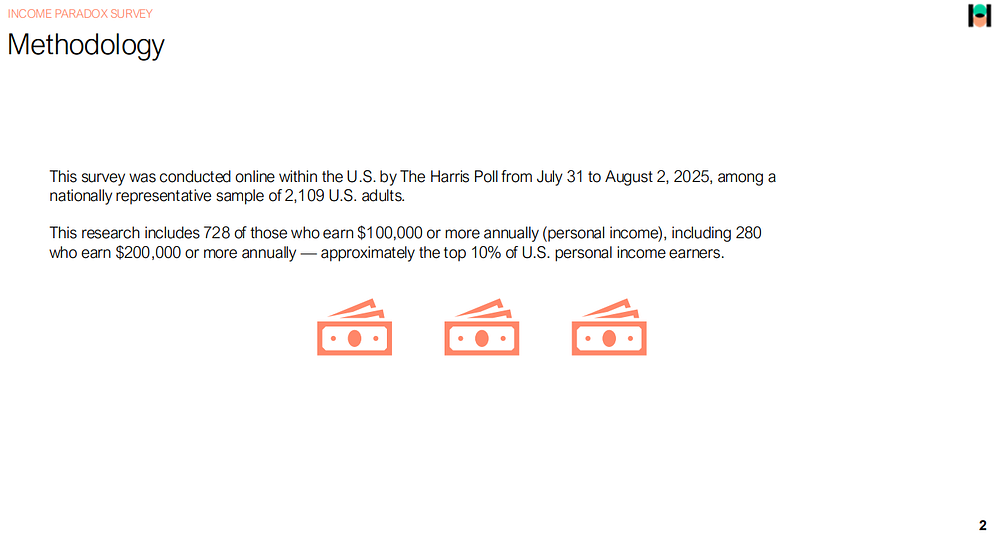
Now, a Harris poll of over 2100 US adults came to conclude thatnearly one-third of six-figure earners say they’re stretched, struggling, or drowning financially.
And 64% of them say that six figures is no longer a sign of wealth but survival mode since their paychecks are used to cover costs, not comfort.
In fact, many reports are showing how even high-income earners live paycheck to paycheck.
Where Investopedia reported that of the Americans earning $300,000 or more, 40% report living paycheck to paycheck.
According to a survey from Bank of America, almost half of the respondents perceive themselves as living paycheck to paycheck, with the number slowly trending upward over the past few years.
Even crazier, a survey that PNC was a part of came out to show that67% of the US workers surveyed say that they are living paycheck to paycheck, which is even up 4% from last year’s survey.
And on top of that, it’s also reported that 42% of Americans don’t have an emergency fund.
It is generally recommended to have 3 to 6 months of your living expenses saved up for the worst-case scenario.
But seeing how many Americans, even the high-income earners, live paycheck to paycheck, let’s now go over the 5 main reasons why Americans feel broke.
Reason #1: Rising Cost of Living
Just a couple of years ago, inflation was at its peak.
And while it has been reduced since, realize that the cost of living is just continuously on the rise.
But the offset here is that typically your income also rises over time, where you can see that since inflation cooled down, wages have remained stronger and have outpaced the rate of inflation. But just like the years before, that isn’t always the case.
According to data from the Federal Reserve, things like buying a home have become much harder to do. Where home buyers today need to earn 43% more than the average worker to afford the typical home.
And if we look specifically at something like child care costs, that is estimated to have risen nearly 30% from 2020 to 2024.
Healthcare costs have also risen significantly, and in just the last year alone, the average utility bills have increased by 12%.
So, because the cost of living has such a large impact on your wallet, many feel that they are falling behind even if their income is stable.
Reason #2: Lifestyle Inflation
You see, according to Parkinson’s Second Law, when speaking financially, as your income rises, your spending naturally increases right along with it.
So, the more you earn, the easier it becomes to increase your lifestyle. Whether that’s a nicer apartment, a newer car, going out to eat more, or vacations, could easily reduce how much you’re able to save.
This is exactly why living below your means is so important. Your savings rate, which is how much you can save when compared to your income, is among the biggest factors that lead to building wealth and having a successful retirement.
Think about it. You simply can’t invest if every pay raise, bonus, or extra savings that you earn is matched with more spending.
That alone is exactly why the legendary investor Warren Buffett once said, “Do not save what is left after spending, but spend what is left after saving.”
Most people do the opposite. And that is exactly why even high-income earners may end up living paycheck to paycheck and still feel broke or at least financially stressed.
Reason #3: High Levels of Debt
Now, according to recent data released by the Federal Reserve Bank of New York, thetotal household debt balances, including mortgages, car loans, credit cards, and student loans, are now at a new record high.
In fact, credit card debt alone is continuously on the rise, with Americans’ total credit card balance being $1.2 trillion as of the third quarter of 2025.
And not to mention, the median average credit card interest rate from August 2025 was roughly 24%.
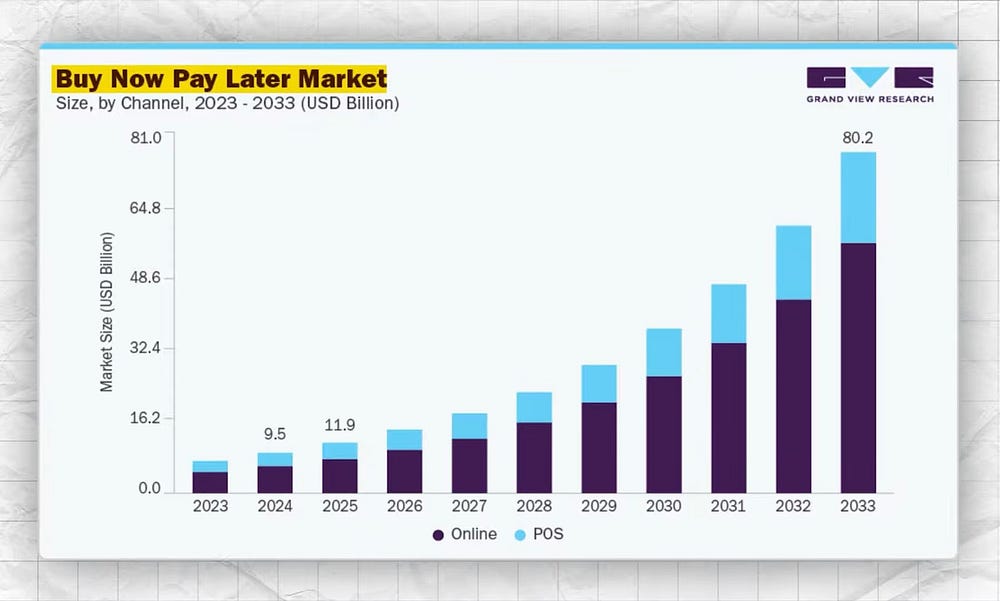
Which things get even worse because the buy now, pay later method is growing at an incredible rate.
And so, largely because of the impact of having high levels of debt, for most Americans, financial success now means being debt-free.
Reason #4: The Comparison Trap
Now, we’re in a time with technology and social media, where it’s never been easier to instantly compare yourself to others.
Whether you see someone buy a new car, house, travel often, or just seem to be living a cool life.
First, realize that most use social media as a highlight reel of their best moments, when in reality, you have no idea what someone’s really going through.
And to be honest, many of the things you may see in someone rich may very well not be wealth in all areas of their life.
So, because of what many see on the outside, the constant pressure to keep up makes many Americans feel like they’re falling behind, even if they’re doing better than they think.
And when you combine rising costs, wanting to improve your lifestyle, high debt levels, and the ease of constantly comparing yourself.
It’s no surprise that many Americans feel broke today.
Reason #5: Lack of Financial Literacy
For many, spending money today is way too easy to do, especially with things like Amazon, credit cards, or even the ability to use the buy now, pay later methods.
3. The Truth About Wealth
The biggest thing to realize here, at least in my opinion, is that there is a difference between being rich and being wealthy.
To me, being rich typically refers to having a high income or flashy things like luxury cars.
That is one of the worst places to put your money. And the truth is, those rich spending habits often lead many people into serious debt problems.
And so, while that can feel exciting in the moment, it’s often a short-term focus on immediate gratification.
And that can also disappear just as fast, create even more stress, and even lead many into an unfulfilled life.
But for those who are genuinely wealthy, it’s typically referred to as having strong financial freedom, personal growth, and long-term security.
Real wealth is about having a strong foundation in your life that goes far beyond just money.
It’s about things like being able to sleep peacefully at night, knowing that you’re in control of your life, feeling that you have a meaningful impact on the world, and yet alone the famous phrase that is health is wealth.
So, while many equate wealth to having loads of money, real wealth, at least to me, is about living a life you truly enjoy without constant stress or worrying about your bank account.
The distinction is really important to understand, and many will view this differently.
But because many Americans feel broke even when earning a high income, even if they feel rich in terms of earnings, they may not be truly wealthy when it comes to long-term financial stability and overall quality of life.
So just keep in mind that everyone’s opinions and financial situations are going to be different.
But in the end, there isn’t just one single number that defines wealth because that truly comes down to many different factors.
Someone may have loads of money and hate their life, while someone else may barely be able to get by, but is beyond thankful and happy to live the life they have because wealth isn’t about reaching a specific dollar amount, but about the overall stability and satisfaction of living the life that you want.
At the end of the day, the most important thing is to start taking action towards your goals.
Thanks For Reading 🙂