The Wealth Formula — 3 Simple Money Systems to Grow Your Wealth
This simple 3-step approach helps you save, grow, and multiply your money consistently over time

Most business owners never build real wealth because they do not use this system to help themselves, their team, and their business define success across 3 major areas.
The biggest problem businesses face is not being able to align their individual team’s goals with the true goals of the organization, and what this looks like is misaligned incentives every day.
You hire people, you bring them on board, you give them an established salary, and they think that they’re doing their job based on whatever it is that you told them to do.
But what you told them to do often isn’t what you want them to do, and what you want them to do has to be tied to the goals of the organization.
Learn the skills to develop themselves to be the type of marketing manager, finance professional, or operations person that can make $100,000 a year, or $120,000 a year, or $150,000 a year for my business to make $3 million.
So, there is this fundamental shift that has to occur when you bring new team members on.
Tell them to understand that their goals are directly tied to the organization’s goals, and as the organization wins, they should be winning, and as they win, the organization should be winning as well.
This is a mutual relationship; it is not that I’m just going to show up, clock in, clock out, and do my day-to-day work.
Meanwhile, the business is trying to grow and needs everybody inside the business to grow alongside it.
And so, to instill this type of culture, a culture where people are interested in their success,
- They’re interested in the team’s success
- They’re interested in showing up, putting in the work, and truly being high performing.
The entry point to this alignment is first having clear organizational goals.
And then hiring people and asking them and understanding truly what their goals are so that you as the business owner can align those goals that they have where this person sees themsel, how they see themselves accomplishing things.
How they see themselves showing up personally, professionally, and financially, so that they can achieve those things through working inside your business.
And if they don’t see that, what happens is disengagement.
Galllup poll in 2026 reported the lowest employee engagement rate in over a decade at over 49% of the workforce.
Think about that, if you have a business that has 10 team members and 49% of the workforce is disengaged, that means that 5 out of the 10 people you have hired to help you go from a million in revenue to $3 million in revenue are disengaged in your business.
So then ask yourself the question, what is the likelihood that your business is actually going to get to 3 million?
Do you even have the confidence that you’re going to be able to maintain at 1 million, knowing that half of your team is disengaged today, much less not preparing for the problems of tomorrow, or a quarter from now, or a year from now?
So the solution for this is aligning goals through this process. And I’m going to walk you through this 3-step process that is truly transformational for you to be able to identify the right talent, align their goals, and actually create a high-performing team inside your business.
Step 1: Personal Goals
What is shocking is how few people can clearly define their personal goals 3 to 5 years out.
The process of the personal, professional, and financial goal framework is that you, as the business owner, sit down with your team members who report directly to you.
And you’re going to ask them their one, three, and five-year personal, professional, and financial goals.
When you sit down and have this conversation with them, you have to remember the frame of mind that they’re in.
When was the last time that somebody sat down with you as a business owner and asked you what your personal, professional, or financial goals were and offered to help you get there?
I have a feeling that if you’re like any of the business owners that I work with, this conversation isn’t coming up over drinks with your friends or casually on a walk. People are not having this conversation.
So, when you think about your team members sitting down with you,
- They’re likely going to be nervous
- They’re likely going to be uncomfortable
- They’re likely not going to know exactly what to share and what not to share.
And starting the whole conversation by talking about personal goals can be very daunting to people.
But what you have to remember is, why do people show up to work every day?
Think about that for a second.
Do you think that they show up so that they can achieve all of their professional wish list items and hit their financial goals?
OR
Do they actually show up for some personal reason that drives their ambition professionally and financially?
I find that most people actually do show up and work hard, and want to achieve things and want to be better to accomplish something personally.
So, even though it’s uncomfortable in a working environment to talk about personal goals, it is the biggest connection point with your team members because they care about being able to take care of their kids and provide a better quality of life to them.
They care about being able to potentially take care of their parents or be there to help cover medical expenses when things get stressful.
People’s personal lives are actually what drives what they do each day inside the business.
So, take the time to understand what their goals are from a 1-year, 3-year, and 5-year outlook.
Most people really understand what one year looks like, but it can be challenging for people to really look at 3 years and 5 years.
And yet, for your business, in order for you to hit $3 million in revenue or $5 million or $10 million or $15 million or $50 million, you have to have a longer time horizon.
You’re not just going to have those numbers happen within 12 months, and you need your teams to start building the skills and competencies to help you get there.
The good news is that this focus on personal goals is all the rage right now.
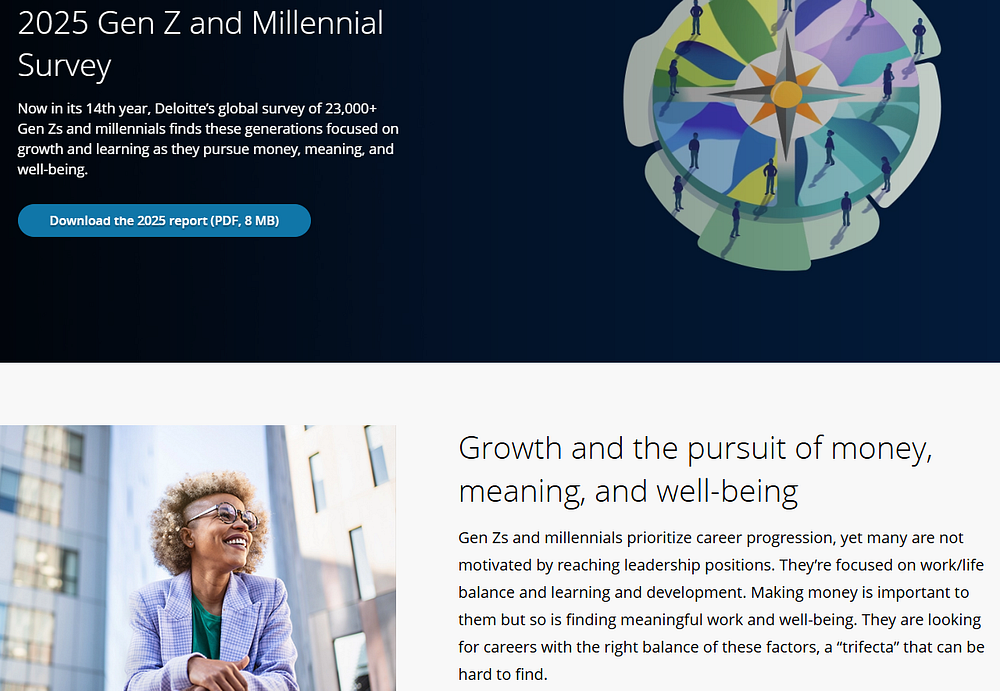
Deloitte’s survey 2025 Gen Z and Millennial survey found that younger workers are pursuing a mix of money, meaning, and well-being, not just compensation alone.
Because you run a business or even manage a team, this is why you have to keep this in mind.
My favorite definition of leadership is making other people’s success easy.
That’s truly what a leader does; a great leader is able to take in a group of people or an individual and help them become successful faster than the leader was able to become successful.
So if you want your team members to be successful inside your business, it will help make your business successful.
Then it’s important to understand what success actually means to them.
One of my single favorite PPF conversations happened with a team member of mine back in 2022.
She came to my house, and we had an hour-long conversation about where she saw herself.
She was starting with an average base salary because she had just come out of chiropractic school and had joined our organization to help lead our medical division.
And during that PPF conversation, I found out that she had substantial financial goals.
She wanted to be making a quarter of a million dollars within the next 18 months.
And that was over twice what she was currently making. So I looked her straight in the face, and I said, “In the role that you’re in, there is not a shot that you’re going to be able to make a quarter of a million dollars. However, if you learned how to sell, you could absolutely have that opportunity and then some if you are that financially motivated.”
So, she came back to me the next week and told me that she was willing to join the sales team.
It took us about 3 months in order for her to transition out of the current role that she was in and move onto the sales team.
Now, let’s just talk about this. She was a she. She was talking to male business owners, and she was a high stabilizer.
This is not exactly the picture of a top-performing salesperson, but she became our best salesperson within 12 months.
Was our best salesperson for two straight years, was our second-best salesperson her third year.
And the only reason that she was second best was that she had gotten married, had had a child, and had gone out on maternity leave, but was still able to bring in over $300,000 that year.
And when we acquired this tiny little health business a handful of years ago.
And needed somebody to help build out systems and processes and the sales team, she was the perfect person because she originally had her chiropractic experience.
So today she is the senior director of wellness across a very large team, making multiple hundreds of thousands of dollars with two kids and a husband.
Now, why share this with you? Yes, was she money motivated? Absolutely.
But her personal goals happened alongside the growth of her professional and financial goals.
It’s so easy to buy into this myth that you can’t have it all and you can’t do it all.
But this is why you have to be so clear about what you actually want.
Because if she wasn’t clear that she wanted to start a family, if she wasn’t clear that she wanted to make more money, she would likely have been stuck in a role that could have been a good role for somebody else, but didn’t actually fit where she wanted to go.
And if we hadn’t asked these questions as leaders in our organization, we wouldn’t have been able to put her in the right place for her to be able to feel great about how she was showing up and for the organization to win.
Because of her tenacity, because of the way that she was dedicated and the discipline that she brought to her own goals.
Step 2: Professional Goals
If your team can’t see a future for themselves inside your business, why would they be engaged every single day?
When you’re sitting down with a team member, talking to them about their professional goals, it is the easiest conversation to have because most team members want you to know what their professional goals are.
- They want you to know that they want a promotion.
- They want you to know that they want you to invest in some sort of education or skills-based learning.
- They want you to know that they want a mentor. And so I find that this part of the conversation is pretty straightforward for people.
But I would strongly encourage you to ask phenomenal questions, because just because somebody wants a promotion.
Let’s say they started as a marketing manager with you, and they tell you that they want to be the chief marketing officer.
Well, that doesn’t mean that in the next 12 months you just make them the chief marketing officer.
So, what is it about being a chief marketing officer that they actually want to be competent in?
- Do they want to be the best at social?
- Do they want to be the best at direct response?
- Do they want to be the best at advertising, at PPC?
What does the chief marketing officer actually mean to that person?
Because once you can unpack this, you then are able to start building them a path of all the things that they don’t currently know as a marketing manager in your organization that they need to know, and ways that you need to push them to be able to communicate.
To be able to show up and have an executive presence because they’ve now stated that they want to be something that they currently are not.
We can all agree that an $80,000 a year marketing manager has a wildly different skill set than an $800,000 a $800,000-a-year chief marketing officer.
The gap is massive. So what do we have to do in the next 12 months to rapidly get that person’s skill sets to have them make closer to 120, and then the next year closer to 200?
- How much revenue would have to come in?
- How many leads would have to be converted?
All of these questions very easily become the responsibility of the person who is actually responsible, instead of you, as the business owner.
This is how you solve disengagement. After all, most disengagement is actually because people are bored today; that Gallup poll that I referenced, it’s because someone’s bored today.
They do not have a big enough problem today, they don’t have a big enough goal today to actually get their necessity level up so high that they show up in a way where they’re present, where they’re active, where they’re paying attention.
And so, your job as a leader is to constantly remind people what the real opportunity is.
Because I can promise you, if you have disengaged people who actually believed that they could be making twice as much money if they followed XYZ steps, they would not show up disengaged any longer; they would be actively trying to figure out how to get those skills.
But if you don’t reverse engineer this process in your business and make it clear to people that you care about their goals, professional goals, and how they actually attain those goals through working with you.
Of course, they’re going to be disengaged because they’re just collecting a paycheck, and they don’t understand what your goals are and what’s possible for them inside your business.
This is the game for the business owner. This is the most important set of problems that a business owner can be solving.
Not having this conversation is where business owners actually lose their potential high performers.
You see, if somebody can’t see a future for themselves inside your company, they entirely stop bringing their full energy into the role.
They clock in, they clock out, and this isn’t because they hate their job or they’re bad people or because they just want to leave tomorrow.
It’s actually because they can’t see the momentum and growth that’s available to them inside their role today, so they check out.
Every person needs to feel like the work that they’re doing today is turning into something that they want to build for tomorrow.
That is why this conversation matters so much inside a business.
One of my team members came to me after 18 months and said, “I want to make more money, and I want to have more influence with our leadership team.”
And the department that this person was responsible for had nothing to do with revenue generation, think legal, think operations, think HR, all internal functions, and those functions traditionally cost money, they don’t generate revenue.
So being able to pay somebody more becomes more difficult because they’re not actually focused on revenue-generating items.
So I put the problem back on her, I said, “What can you do that would solve a problem that would help us make more money or decrease our expenses?” So she came back to me the next week.
And she said, “I do this thing very well inside our internal organization and I think our clients would want to have this same service provided to them because I know our clients also struggle with this, so I propose that we launch this service and that will help me not just make more money myself, but also have a larger team and have more influence across our leaders because I’m working directly with our clients, not just our internal teams.”
This is the exact type of problem-solving that you want in your business.
You want people to want to make more money; you want them to come to you with creative solutions as to how they can make more money, that’s adding value to your business.
And fast forward a handful of years, this team member has a full-blown service department with many clients who get serviced by her and her team, and the clients are thrilled; she’s making more money.
And she did accomplish her goals of working closer with our clients and getting more influence and buy-in with our leadership team.
The more you can lean into and get your team members to trust you when they tell you what their goals are, the better chances you have at actually pushing them in a direction that can be very uncomfortable but lead to the exact growth that you want to have.
Step 3: Financial Goals
Financial goals, because once the personal and professional goals are clear, you have to put actual numbers behind them.
It can be very difficult to talk to people about their financial goals.
Because the reality is, most people have very vague financial goals, like saying, “I want to pay off debt.” Okay, how much debt?
They say they want to buy a boat. Great, is this a $5,000 boat, or a $200,000 boat, or is it a $5 million boat?
They say they want more money, but compared to what, by when, for whom? That is the problem.
Most people are emotionally attached to the idea of financial success, but they’re not operationally clear on what they’re solving for.
And the moment your team puts a real number on the life they want, they may realize that their current career path can’t actually fund it.
This is why the third step of this framework matters so much. Once the personal side and the professional side are clear, you have to define what those goals actually cost for the people on the team because this is what separates people who are successful from people who are unsuccessful.
People who are successful in any role across any business.
In any field, the ones who are successful actually understand that they want something that they don’t have, and they’ve calculated what it’s going to take to get there, and they don’t underestimate how hard it’s going to be to get there because they’re honest with themselves.
But if they’re not honest with themselves about how much money they want to make to have the lifestyle that they have, of course, they’re going to be dropped into being disengaged.
They’ve given up entirely on the dream; they’re settling for $80,000 a year, $60,000 a year, $120,000 a year because $200,000 seems out of reach.
They don’t know how to get there, they don’t know what they have to learn, there’s confusion, there’s complacency, there’s a lack of clarity.
And for the best leaders, they recognize that this very thing is their job to help their team with.
So, you’re going to sit down with your team members and have the PPF conversation.
You’ve gone through 1, 3, and 5-year personal professional goals, and now we’re going to dive into financial goals.
Hit hard on the three-year and 5-year financial goals.
- What does that person want their net worth to be?
- What type of living environment does that person imagine themselves in?
- What type of trips can that person take?
Because all of that is available to them, whatever it is that they desire through the growth of your business, if you structure it correctly.
But if you put this lid or a cap on where people think that they can go inside your business, they’re never going to think about bigger things, and therefore, they’re never going to put the energy or the output into solving the right problems inside your business.
This is a recipe for failure.
You want them to have aggressive financial goals so that they can add value at the same level of proportion to the goals that your business has.
And so when you get to the three and five-year financial goals, really ask the hard questions: how much debt, how much do you want to be able to spend?
When you help your team members dream and you breathe life into their goals, they, for the very first time, have a reason to care about your goals.
My husband said something to me over a decade ago that changed the trajectory of my life. He said this very simple statement.
“Why would anybody care more about your goals than they do about their own?”
If you really think about that as a business, what are you asking people to do every single day?
You’re asking your team to care about your goals, to have your business grow from $1 million to $3 million, to have them care about your customers, your clients, your patients, your products, your services, whatever your business does, you’re having people care about those things.
But if they don’t even care about their own goals and they don’t believe that they can accomplish their goals, why on earth do you actually think that they would care about your goals?
Of course, they’re going to be disengaged. So, it’s your job to foster an environment where people are winning and people demand of your business and your culture that it sets a bar and an environment and a precedent for them to be successful through working alongside you.
When somebody can clearly see that their winning inside their role helps them win personally, professionally, and financially, their effort inside your business changes completely.
That is how this framework creates wealth across all three buckets for the team and for the business itself.
So, this was the personal, professional, and financial goal framework that has helped thousands of businesses align their team members’ success with the business’s success. At this at home.
Thanks For Reading 🙂